
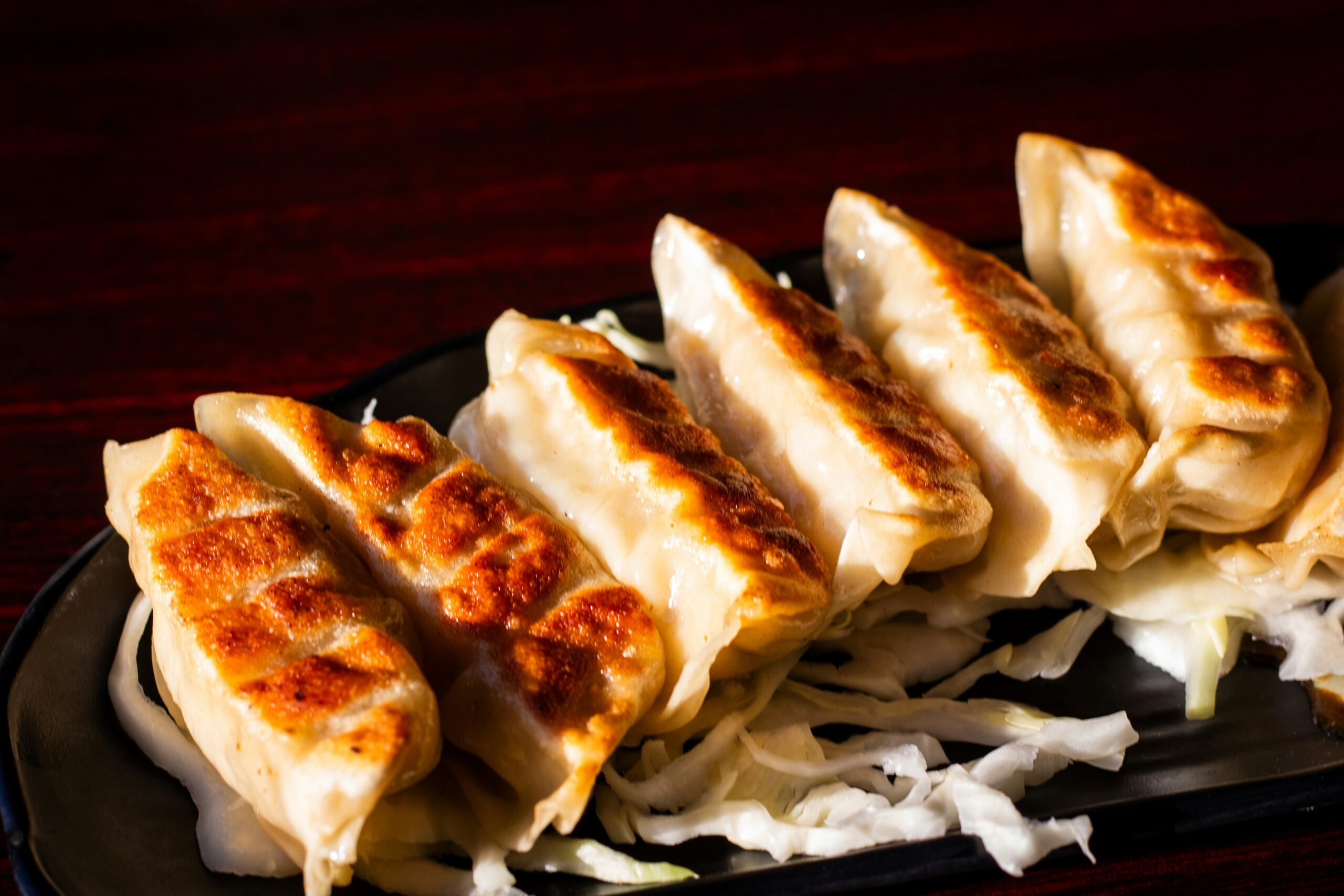
Gyoza vs Jiaozi — What’s the Difference?
They look nearly identical. Both are crescent-shaped, both are made from thin wheat dough wrappers with a savoury filling, and both are usually served with a vinegar-based dipping sauce. But gyoza and jiaozi are distinct dishes with different histories, different flavour profiles, and different culinary contexts. Understanding the difference makes you a better dumpling eater.
The Origin: Same Root, Different Paths
Jiaozi is the older of the two. Chinese dumplings have been eaten for over a thousand years, with some historical accounts tracing handmade filled dumplings to the Tang Dynasty (618–907 AD). Legend attributes their invention to Zhang Zhongjing, a physician who created ear-shaped dumplings as a warming medicine for villagers suffering from frostbite. Whether or not the legend is accurate, jiaozi became deeply embedded in Chinese culinary culture — particularly in northern China, where they are eaten at Lunar New Year and symbolise wealth and good fortune (their shape resembling ancient gold ingots).
Gyoza entered Japan in two stages. First introduced in the early 19th century from mainland China, the dish initially failed to take hold. It was only after World War II — when Japanese soldiers returning from occupied Manchuria and China brought back a craving for the street food they had eaten — that gyoza became established in Japanese cuisine. Japanese cooks adapted the recipe to local ingredients and tastes, and the result was a new dish: related to jiaozi but meaningfully different.
Key Differences
The Wrapper
Gyoza wrappers are typically thinner than jiaozi wrappers. In Japan, machine-made wrappers are the norm even in restaurant kitchens, producing a uniform, delicate skin. Chinese jiaozi wrappers are more commonly handmade, resulting in a slightly thicker, chewier texture that holds up better to boiling. The thin gyoza wrapper is what produces the characteristic crisp base when pan-fried.
The Filling
Both typically use pork as the base, but the seasoning philosophy differs. Japanese gyoza fillings lean heavily on garlic — more so than most Chinese jiaozi. The filling is also more finely minced in gyoza, producing a smoother texture. Chinese jiaozi fillings vary significantly by region: northern varieties often use pork and cabbage or pork and chive; southern varieties may use prawn, pork and prawn combinations, or vegetable-only fillings.
The Cooking Method
This is the most visible difference. In China, jiaozi are most commonly boiled (shuijiao) or steamed (zhengjiao). Pan-fried jiaozi — called guotie or potstickers — exist but are considered a distinct variation. In Japan, gyoza are almost exclusively pan-fried using the yaki-gyoza technique: fried on one flat side until golden, then water is added to the pan and a lid placed on top to steam the top of the dumpling. The result is a dumpling that is simultaneously crisp on the base and tender on top.
The Dipping Sauce
Jiaozi are traditionally served with Chinese black vinegar (Zhenjiang vinegar) and sesame oil, sometimes with ginger slivers. The sauce is sharp and complex. Gyoza are served with a blend of soy sauce, rice vinegar, and chilli oil — lighter and more straightforward. The sauces are not interchangeable — each is calibrated to the specific flavour profile of its dumpling.
Which Is Better?
This is the wrong question. Gyoza and jiaozi are two branches of the same family, each optimised for a different culinary context. Gyoza excels as a side dish — crisp, punchy, designed to be eaten quickly alongside ramen. Jiaozi is a meal — substantial, varied, central rather than peripheral. Asking which is better is like asking whether a side salad or a main course is superior. They serve different purposes.
Both styles are available in Edinburgh. For our guide to where to find the best of each, see our Edinburgh dumplings guide.